
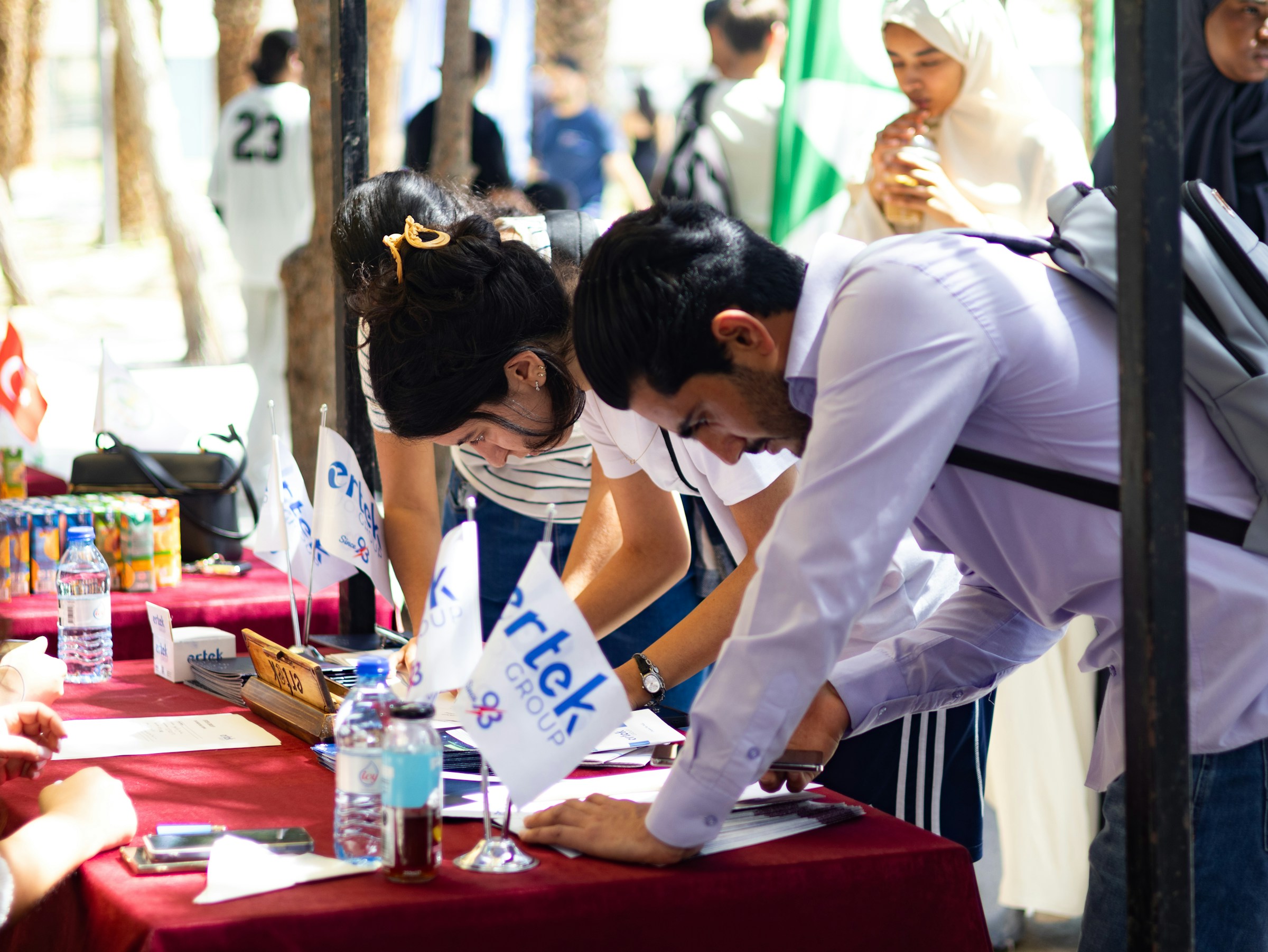
Career Fairs and Networking Events in Switzerland: A Guide for Students & HR teams
Looking for an internship, graduate programme or your first full-time job in Switzerland?
One of the best things you can do is actually talk to the people behind the companies you’re considering.
Career fairs and networking events give you that opportunity. You can meet recruiters and employees, ask the questions that aren’t answered in a job description and get a better idea of where you might actually want to work.
But you don’t have to wait until the next career fair comes to your campus.
On CareerFairy, you can join employer Live Streams throughout the year to meet recruiters, graduates and future colleagues online. You can hear about real jobs and graduate programmes, learn what working at a company is actually like and ask your own questions directly to the people who work there.
Explore upcoming CareerFairy Live Streams →
Then, when career fair season comes around, make the most of that too.
Switzerland has a strong university career-event scene, from huge recruitment fairs with hundreds of employers to smaller industry events, workshops and networking sessions.
Here are some of the career fairs and networking opportunities Swiss students should know about – plus how to get much more out of them.
Why go to a career fair as a student?
The biggest reason isn’t collecting free pens.
It’s access to people.
At a good career event, you can speak directly with recruiters, graduates and employees and learn things that are difficult to understand from a careers page alone.
The University of Zurich’s Career Services, for example, offers everything from employer career events and its JobHub to CV checks, mock interviews and individual career advice. Its events calendar also includes employer-run events alongside university career workshops.
And there’s another important point: you don’t need to arrive knowing exactly where you want to work.
Career fairs can help you at several stages of your search:
- Exploring: Find companies and career paths you hadn’t considered before.
- Researching: Speak to employees and understand what different jobs are actually like.
- Applying: Learn about internships, graduate programmes and entry-level positions.
- Standing out: Make a human connection before or during your application.
- Building your network: Meet people you can stay in touch with after the event.
The best outcome from a career fair isn’t necessarily walking away with a job offer that afternoon.
It could be discovering an employer you’d never considered. Or understanding which graduate programme actually fits you. Or leaving with the name of someone you can contact when you apply.
Career fairs and networking events in Switzerland
Which events are worth attending will depend heavily on your university, subject and the industries you’re interested in.
Here are some of the major ones to have on your radar.
Forum EPFL – Lausanne
If you’re studying at EPFL – particularly in engineering, technology or science – Forum EPFL is one of the biggest dates in the Swiss student recruitment calendar.
The 2026 edition takes place from 5–9 October 2026 at the SwissTech Convention Center.
And it really is big: the organisers list 188 companies, 133 start-ups and 18 NGOs/IGOs for the 2026 edition.
Don’t think of Forum EPFL as simply rows of employer stands, either.
Students can take part in company presentations, workshops, networking lunches and interviews. There’s also a Skills Week before the main Forum where students can get help with CVs and cover letters and prepare for interviews.
Students can also upload their CV to the Forum’s CV library, making it available to participating employers.
See what’s available for students at Forum EPFL →
If you’re going, it’s worth looking at the employer list beforehand rather than trying to decide where to go once you’re standing inside a huge recruitment fair.
Pick your priority employers first – and then leave a little space for companies you’ve never heard of.
HSG Banking Days – St. Gallen
Know that finance is where you want to be?
A specialist event can sometimes be even more useful than a general career fair.
The HSG Banking Days run from 28 September to 9 October 2026, bringing 39 Swiss and international financial firms to the University of St. Gallen.
That includes organisations ranging from global banks and asset managers to private banks and specialised financial boutiques.
The advantage here is focus.
Rather than spending a day jumping between completely different industries, you can use the event to compare employers and career paths within finance and speak to people already working in the industry.
HSG also highlights examples of students whose conversations at previous Banking Days led to interviews and even graduate opportunities.
So if you’re already considering banking, asset management or another finance career, this is the type of event where arriving with specific questions can really pay off.
HSG Career Days – St. Gallen
If banking isn’t your thing, HSG also runs broader Career Days from 12–21 October 2026.
The 2026 programme brings together 41 companies across:
Legal, Insurance, Luxury, FMCG, Tech, Consulting and Industry.
Different industries have dedicated dates and formats, making it easier to concentrate your time on the sectors you’re genuinely considering.
For example, if you’re exploring both consulting and tech, you can use the event to understand how the work, entry routes and company cultures differ rather than relying entirely on what you read online.
Polymesse – ETH Zurich
For students in Zurich, Polymesse is another major event to know.
The annual three-day fair takes place at ETH Zurich and attracts 140+ national and international companies as well as start-ups.
The 2026 edition ran from 21–23 April 2026 at the ETH Zurich main building and Polyterrasse.
It’s not only for people who already have a particular employer in mind.
Polymesse is open to students and doctoral candidates across disciplines, including students from universities beyond ETH, and is designed for everything from exploring internships to looking for full-time roles and simply meeting people from different industries.
So while the 2026 fair has already taken place, it’s worth putting the next edition on your radar if you’re studying in or around Zurich.
Career events at the University of Zurich
UZH students should also keep an eye on the university’s Career Services calendar.
Rather than relying on one giant annual fair, UZH runs and lists different career activities throughout the year, including career workshops, employer events, CV checks and other opportunities to meet companies.
See upcoming UZH career events →
That makes the calendar worth checking regularly rather than only when you’re actively applying.
You might find a workshop that helps you prepare your application one week and an event with an employer you’re interested in the next.
UZH also explicitly offers employers virtual events through CareerFairy, giving students another way to meet companies regardless of location.
VBS Career Day – Bern
Career events aren’t limited to consulting firms, banks and large private companies.
The Swiss Federal Department of Defence, Civil Protection and Sport (VBS/DDPS) is holding its Career Day in Bern on 4 November 2026.
It’s aimed at students and graduates from universities and universities of applied sciences.
The range of careers may be broader than you expect.
The VBS highlights fields including cybersecurity, intelligence, procurement, geoinformation, civil protection, sport and communications, and says it encompasses more than 200 professions.
Students can hear directly from current university interns, speak to HR representatives and specialists, learn about internships and entry opportunities and network with employees and other students.
If you’ve automatically associated public-sector careers with only a handful of degrees, an event like this is a good opportunity to challenge that assumption.
What about networking events that aren’t career fairs?
Don’t restrict your search to events with “career fair” in the title.
Universities across Switzerland organise smaller employer events, company presentations, workshops, networking evenings and industry-specific sessions.
These can sometimes be more useful than a huge fair.
Why?
Because a smaller event gives you more time.
Instead of waiting behind ten other students at an employer stand, you may get 15 or 20 minutes to actually talk to someone.
Check:
- Your university Career Services calendar
- Your faculty and department newsletters
- Student associations and Fachschaften
- Individual company career pages
- LinkedIn events
- CareerFairy Live Streams
And don’t only look for events when you’re already applying for a job.
If you start attending them six or twelve months before graduation, you can use them to work out where you actually want to apply.
How to prepare for a career fair or networking event
You don’t need a rehearsed sales pitch and 50 printed CVs to have a useful conversation.
But turning up completely unprepared makes things unnecessarily difficult.
1. Pick your companies before you arrive
If 100 employers are attending, don’t try to speak to 100 employers.
Choose perhaps five to ten that genuinely interest you.
Look at their current internships, graduate programmes and junior positions. Find out what the company actually does and identify the teams that could be relevant to your studies.
Then leave some time for companies you discover spontaneously.
That balance matters.
You want enough preparation to have good conversations without becoming so focused on five famous employers that you walk straight past a company that might actually be a better fit.
2. Prepare better questions
Avoid starting with:
“So… what does your company do?”
You can find that online.
Instead, use your limited face-to-face time to ask something you couldn’t easily find on the company’s website.
For example:
“I saw you’re recruiting for your graduate programme. What tends to distinguish the graduates who do really well in the team?”
Or:
“I study mechanical engineering, but I’m interested in moving towards data. Have you seen graduates make that kind of transition in your company?”
Or even:
“If you were applying to this team as a graduate today, what would you want to know before applying?”
Specific questions create better conversations.
And this applies online too. If you’re joining a CareerFairy Live Stream, look at who’s speaking beforehand and think about what that particular person could tell you that a job description can’t.
3. Know your 20-second introduction
You don’t need an “elevator pitch” that sounds as though you’ve memorised it.
Just be able to explain three things:
Who are you? What are you studying? What are you looking for?
For example:
“I’m doing my Master’s in Data Science at ETH and graduate next summer. I’m currently exploring graduate roles where I can work on real machine-learning applications, so I wanted to learn a bit more about your team.”
That’s enough to start a conversation.
4. Talk to employees, not only recruiters
Recruiters can tell you how the application process works.
Employees can tell you what the job is actually like.
If companies bring recent graduates, trainees or junior employees to an event, speak to them.
Ask:
What surprised you after joining?
What does a normal week look like?
What did you wish you’d known when you applied?
What was your own route into the company?
These are also some of the most useful questions to ask during CareerFairy Live Streams when recent graduates or employees are among the speakers.
The goal isn’t just to understand how to get the job.
It’s to understand whether you’d actually want it.
5. Don’t ignore companies you don’t recognise
This is probably one of the easiest career-fair mistakes to make.
You see the name of a famous bank, consulting firm or consumer brand and join the queue.
Meanwhile, there’s another company 20 metres away doing exactly the kind of work you’re interested in – and nobody is waiting to speak to them.
Use career fairs to discover, not just validate the companies you already know.
The same applies when browsing online career events. An unfamiliar company can still have exactly the graduate programme, internship or team you’re looking for.
6. Follow up
This is where “I went to a career fair” turns into actual networking.
If you had a useful conversation, connect afterwards.
Remind the person where you met and mention something specific you discussed.
Don’t just send:
“Hi, I’d like to add you to my professional network.”
A short personal message is much more useful:
“Hi Anna, great speaking with you at the career fair today about the Data Graduate Programme. Your point about the first rotation was really useful – thanks again!”
Now, if your name appears again – perhaps on an application – it might not be completely unfamiliar.
The best approach? Combine online and offline
You don’t have to choose between career fairs and online events.
They solve slightly different problems.
Use large career fairs to explore employers, compare industries and discover companies you hadn’t considered.
Use smaller networking and industry events when you want more focused conversations.
And use CareerFairy Live Streams throughout the year when you want to go deeper into a particular company, graduate programme, internship or career path without having to wait for the next physical fair.
On CareerFairy, you can meet the people behind employers, ask questions live and learn about the actual opportunities available to students and graduates.
See upcoming CareerFairy Live Streams →
Then take what you learn and use it when you apply.
Because ultimately, good networking isn’t about collecting as many LinkedIn connections as possible.
It’s about replacing an anonymous company with real people – and figuring out which of those people, teams and opportunities could be the right next step for you.

Amal Thomas Roy
Speak to a CareerFairy Account Manager
Learn how CareerFairy can help you Attract, Engage & Hire Gen Z
Book a demo now


